
From the Snowy Table workshop
Provence-Style Vetiver Soap with a Rolling Pin
Make Provence-style vetiver soap with a rolling pin, a pronounced woody-floral fragrance, and a separate scent tile and pilot before the main lot.
- Setup150 min
- Active369 min
- TotalAbout 9 hours active, plus at least 12 weeks and 3 days of waits
- Yield2 target oversized bars from one main lot; actual yield varies
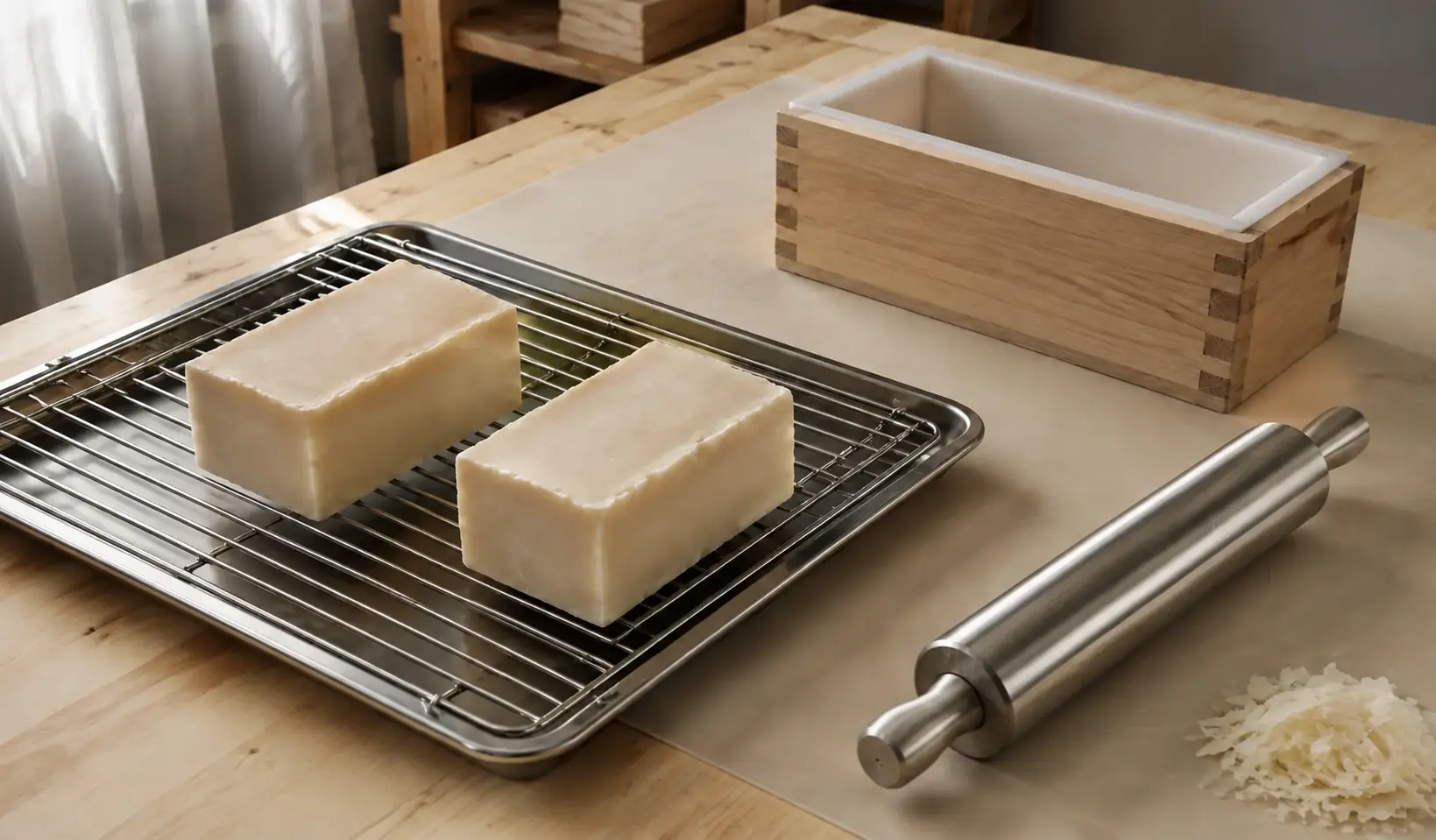
Non-food project
A woody, floral soap shaped by hand
Paid links in this story: As an Amazon Associate I earn from qualifying purchases.
Provence-style vetiver soap starts with an already-made base, a pronounced woody-floral fragrance and the patient work of folding, rolling and pressing. No sodium hydroxide is added, but hot water can burn and fragrance concentrates can irritate or sensitize skin. Prepare the workspace and read every material's safety directions before beginning.
The aim is an aromatic bar with vetiver depth and rounded florals. Snowy Table has not physically tested or laboratory-verified this formula. Compare scent and texture with fresh current-production reference bars. Quantities, yield and conditioning times are estimates. Hand rolling cannot reproduce industrial French milling. The image is an illustration, not a photograph of a tested batch.
Set up the workspace for safety
Paid links in this section.
Clear a washable surface, ventilate the room and exclude children, pets, food, smoking, sparks and ignition sources. Put on chemical splash goggles and chemical protective gloves selected from the materials' SDS, with long sleeves and closed shoes. Use heat protective gloves for the water bath. Keep running water accessible and follow the exact SDS: flush eyes with water, wash exposed skin and remove contaminated clothing, and move to fresh air after inhalation. Obtain prompt poison-center or medical advice after swallowing; do not induce vomiting. Never apply fragrance concentrate to skin.
Before the scent tile, obtain current exact-product documents, the complete mixture's Category 9 conformity information, allergen information and a competent assessment of shared restricted constituents and finished-soap concentration. Require explicit Lilial/BMHCA and Lyral/HICC absence declarations for the proprietary fragrance oils; essential-oil purity statements are not named nondetection assays. The 2.5% paper screening ceiling is conditional and does not certify this blend or replace that assessment. If the paperwork or materials do not support the formula, stop. Keep every contact tool dedicated to soap and pressing loads low and stable.
Choose the base and prepare small, accurate additions
Paid links in this section.
Use Candora Soap Noodles BA-SN, whose published soap salts are approximately 80/20 palmate to palm kernelate. Obtain the current specification and lot moisture; this ratio does not identify the factory's oil charge. The base already contains salt, palm-kernel acid and chelators, so add none separately.
The finishing additions are O&3 INKY refined shea oil K0427, fresh refined high-oleic sunflower oil and Escentials Australia Rosemary Oleoresin Antioxidant. Check the ROE's sunflower carrier, 5–6% carnosic acid and product-rate directions. Weigh it; do not dose it by smell: it is an antioxidant, not the rosemary perfume note. This project establishes no antioxidant performance or shelf life.
Check a precision scale, a 0.1 g bar and bulk scale and calibration weights at their actual working ranges. The precision balance must reliably weigh the tile's 30 mg ROE charge; a fine display alone is insufficient. Use dedicated weighing cups and a silicone spatula. In a covered pigment cup, combine cosmetic yellow iron oxide, cosmetic brown iron oxide and vegetable glycerin in the stock amounts below. Contain dust and stir before every withdrawal. Reserve distilled water for the bounded adjustment demonstrated by the pilot.
Build a pronounced woody-floral fragrance
Paid links in this section.
The blend combines NDA Indonesian vetiver, NDA Virginian cedarwood and Eden Botanicals Patchouli Light 775 for its woody base. Eden Botanicals Geranium, Rose EO 375, NDA Moroccan cineole rosemary and NDA Scotch pine add the herbal direction. NDA Lily of the Valley, NDA Neroli and NDA Rose Bouquet fragrance oils round out the floral portion. Use these exact products; scent names alone do not identify interchangeable materials.
Weigh the fixed proportions into a compatible closable fragrance container, mix thoroughly and rest for 24–48 hours within the suppliers' directions. Prepare a fresh master for each phase. Compare one scent tile at 24 hours, seven days and 28 days. For a gentler scent, lower the total dose only within the blend's documented soap-use directions. For a different floral balance, adjust the geranium share only within the exact product's and whole blend's documented limits. Record any revised proportions and finished-soap concentration calculation, then make a new tile before the pilot. Keep the recipe's fixed amounts as the default; never top up mixed soap by smell.
Let the pilot guide the main bars
Paid links in this section.
Keep a notebook and labels for the separate 100 g noodle tile, 500 g noodle pilot and 720 g noodle main lot. After the tile decision, make the pilot with its own fresh fragrance and color stocks. It needs at least four weeks of conditioning before the main lot begins. Make one roughly 370 g pilot blank and smaller pieces for inspection; keep the large blank unwashed and uncut until its stable mass is recorded. Actual drying and handling losses determine later bar size.
The first development sequence contains 28 days for the tile, at least 28 days for the pilot and at least 28 days for the main bars, plus three fragrance rests and the making sessions. Plan about nine hours of setup and active handling, with additional time for slower material behavior. Two finished 340.2 g bars are a target, never a guaranteed yield.
Warm, roll and press with close attention
Paid links in this section.
Put the soap in two sealable heat-rated silicone bags. Check temperatures with a digital probe thermometer. Set a stainless-steel water-bath bowl on a heat-resistant mat, fill with a heat-safe jug and keep a dedicated towel ready. Use immersion-rated bags and confirm material compatibility; neither food-contact labeling nor temperature ratings certify this formula. Keep the bath off heat. Remove and dry the bags before opening to probe; never puncture them underwater. Stop for a leak or admitted bath water.
Use a dedicated smooth rolling pin between two silicone rolling mats. Cut successive sheets with a bench scraper and check thickness with a ruler. The flakes should join under a firm pinch without grains or wet streaks.
Pack thin layers into a rigid, fully lined loaf mold, tamp with a flat stainless-steel hand tamper through one intact rolling mat, keeping excess outside the mold. Add a lined follower. Apply low, stable pressing weights gradually. Stop for a shifting load or bowed mold; drying will not repair poorly joined flakes.
Give each bar room to finish
Paid links in this section.
Set the bars on a dedicated rack and tray beneath a loose dust cover that preserves airflow. Keep them cool, dry and away from sun. Weigh and turn weekly. Wait at least four weeks and require two consecutive weekly mass changes below 0.25%, sound structure and a supported fragrance concentration at the actual finished mass.
Only after these checks, use breathable paper bands and a draining soap dish between washes. This is drying and conditioning of an existing soap base; it cannot make an excessive fragrance dose acceptable. Stop using a bar that irritates. Take pleasure in the hand-shaped finish while judging scent, seams and drying honestly, without expecting a particular commercial texture or perfume match.
What did you notice about the rolling texture and the scent after conditioning? Share your observations in the project discussion. Leave a comment.
The how-to guide
Materials, tools, and method
Read the safety notes first, keep the listed batch amounts fixed, and follow each step in order. Do not scale this project in the card or print view.
Provence-Style Vetiver Soap with a Rolling Pin
Equipment
Paid links in this list: As an Amazon Associate I earn from qualifying purchases.
- 1 checked precision scale Use a suitable precision balance with at least 50 g total capacity for separate small charges and their cup; the AWS GEMINI-50-SIL is a specification candidate, not a verified dosing instrument. Prefer 0.001 g readability and require reliable 0.03 g (30 mg) net additions in the actual tared cup. Tare does not restore capacity. Follow the exact manual and check weights; do not proceed if the range or accuracy is inadequate.
- 1 checked bar and bulk scale 0.1 g increments, adequate total capacity for container plus contents, and checked performance in the bar/bulk range. The OXO 6-lb model starts measuring at 0.5 g; never use it for tiny additions. Keep dry and dedicate to non-food work.
- 1 set small-mass and bulk calibration weight set Suitable checked weights covering the actual precision and bulk weighing ranges; follow each scale's instructions.
- 1 set dedicated weighing cups Enough compatible labeled cups for separate masses without mixing materials prematurely.
- 1 compatible closable fragrance container Supplier-compatible, clean, dry and closable, with mixing headspace for 100 g stock. Use fresh clean containers for each phase. Keep an additional compatible lidded container separately labeled for permitted minor-spill waste; never return it to fragrance or food use.
- 1 compatible covered pigment cup Dedicated cup with mixing headspace for 10 g dispersion; use a fresh dispersion for each phase.
- 1 dedicated silicone spatula Compatible with oils, pigments and the intended soap temperatures.
- 1 set notebook and labels Record exact materials and lots, weights, temperatures, dates, water additions and observations; label every stock and bar.
- 1 pair 3M chemical-splash goggles 91252H1 Suitable splash protection; follow product SDS instructions.
- 1 pair or replacements as needed chemical protective gloves Select material and protection for each exact concentrate from its SDS and the glove manufacturer's chemical information. Inspect before use; obtain the correct size and replacement pairs. Replace damaged or contaminated gloves promptly. Do not assume a blend-specific breakthrough duration, immersion protection, or wash-and-reuse schedule.
- 1 pair heat protective gloves For the warm-water vessel; do not assume chemical gloves also protect against heat.
- 2 sealable heat-rated silicone bags Use two bags manufacturer-rated for the stated water-bath temperature, with kneading room and two complete unstrained closures; choose a larger outer bag if needed. Food-contact and temperature ratings do not establish chemical resistance to this formula: confirm suitability for the exact materials before processing. Keep closures above water and reject damage or leaks. The linked bag is sold singly, not a verified nested kit.
- 1 digital probe thermometer Suitable range and probe for water and soap core; clean and dry between checks.
- 1 large stainless-steel water-bath bowl Stable, large enough for the double bag and warm water without overflow; no direct heat under the bag.
- 1 heat-safe water jug For safely carrying and replenishing warm bath water.
- 1 heat-resistant mat One separate mat under the stable off-heat warm-water bowl, not one of the two rolling mats. Temperature tolerance does not guarantee every countertop finish is protected; no hotplate or flame beneath it.
- 1 dedicated drying towel Keep one clean cotton towel only for drying bag exteriors. Reserve separate spare absorbent cloths for minor spills only where the exact SDS permits safe cleanup; never reuse a contaminated cloth for the bags or food.
- 1 dedicated smooth rolling pin Smooth, intact and permanently non-food after soapmaking use.
- 2 silicone rolling mats Two separate intact mats large enough to enclose the soap, in addition to the bath mat. Confirm suitability for soap and warm oils. Do not cut or puncture them; move exposed soap to the clean, dry, non-food, soap-compatible, scraper-tolerant worktop for cutting.
- 1 dedicated bench scraper For cutting ribbons, strips and flakes on the dedicated surface.
- 1 dedicated ruler For sheet thickness and layer measurements.
- 1 rigid loaf mold with complete silicone liner Sufficient working capacity for one lot; fully supported and stable under the modest press load.
- 1 flat stainless-steel hand tamper A smooth flat 51 mm stainless-steel base for gentle hand packing through an intact rolling mat. Keep the mat flat over the soap with excess outside the mold. Check clearance; never hammer, use a glass jar, or apply high force.
- 1 flat lined mold follower Obtain a smooth rigid follower made to fit just inside the lined mold with one intact rolling mat covering the soap beneath it. Allow for mat thickness, keep excess outside the mold and use no exposed sharp edges. A lid resting on the rim is not a follower. No cutting or woodworking is part of this method.
- 1 set low stable pressing weights Use separately dedicated low compact weights on the lined follower, centered and in one stable level; no tall stack or high-force clamp. Stop if the mold bows or load shifts. No validated pressing force is claimed; do not use contaminated pressing weights for scale checks.
- 1 set dedicated cooling rack and tray Soap-compatible rack with airflow around each bar and a tray below.
- 1 loose dust cover Protects without sealing bars or blocking airflow.
- as needed breathable paper bands Use open-ended paper sleeves only after conditioning and checks; measure the actual bar circumference and allow closure overlap. Keep adhesive off the soap. Choose an appropriate longer sleeve if needed; no guaranteed package fit.
- 1 draining soap dish Large enough to support the finished bar and let it drain between uses.
- 3 current-production Provence Sante Vetiver reference bars Obtain three current-production 12 oz Vetiver Big Bars from one identified lot; record the lot and purchase date. Keep one sealed, one for fragrance comparison and one for physical comparison. These are comparison supplies, not ingredients. Confirm lot identity with the seller before buying.
Materials
Main fragrance stock: make 100 g; use only 16.20 g per main lot
Paid links in this list: As an Amazon Associate I earn from qualifying purchases.
- 18 g New Directions Aromatics Vetiver Essential Oil 00162 Indonesian vetiver essential oil. Main fragrance stock amount only; the completed stock contributes 16.20 g to one main lot.
- 17 g New Directions Aromatics Cedarwood Essential Oil Virginian 00045 Juniperus virginiana wood oil; use this exact Virginian product.
- 5 g Eden Botanicals Patchouli Light 775 Use Eden Botanicals product 775, not New Directions Aromatics patchouli or an unspecified substitute.
- 13 g Eden Botanicals Geranium, Rose EO 375 Use Eden Botanicals product 375. The fixed default is 13 parts in the 100-part fragrance stock. For a different floral balance, adjust the geranium share only as a separately recorded formula within this exact product's and the whole blend's documented soap-use limits. Record the revised proportions and finished-soap concentration calculation, then make a new scent tile before the pilot. Do not top up mixed soap by smell.
- 7 g New Directions Aromatics Rosemary Essential Oil ct Cineole Morocco 00816 Use this exact Moroccan cineole product, not a different chemotype or origin.
- 4 g New Directions Aromatics Pine Scotch Essential Oil 00132 Use this exact Scotch pine product.
- 20 g New Directions Aromatics Lily of the Valley Fragrance Oil 00443 Use the named fragrance oil, not a botanical oil or diffuser product.
- 9 g New Directions Aromatics Neroli Fragrance Oil 00673 Use the named fragrance oil, not neroli essential oil.
- 7 g New Directions Aromatics Rose Bouquet Fragrance Oil 00825 Use Rose Bouquet, not Rose Garden. Keep the exact supplier identity.
Color stock: make 10 g; use only 1.08 g per main lot
- 0.90 g soap-stable cosmetic yellow iron oxide Use Mystic Moments Yellow Oxide Mineral Powder, CI 77492, for the 10.00 g color stock only. Confirm current exact-product cosmetic purity and soap-use directions. Keep powder contained, avoid breathing dust and follow its SDS.
- 0.10 g soap-stable cosmetic brown iron oxide Use Mystic Moments Brown Oxide Mineral Powder, the CI 77491/77492/77499 iron-oxide blend, for the 10.00 g color stock only. Confirm current exact-product cosmetic purity and soap-use directions. Keep powder contained, avoid breathing dust and follow its SDS.
- 9.00 g vegetable glycerin For the 10.00 g color stock only; only 1.08 g of the complete stirred dispersion goes into one main lot.
One fixed main lot: stocks above are withdrawn separately
- 720.00 g Candora Soap Noodles BA-SN Pre-saponified palm/palm-kernel soap base. Obtain current SDS, specification and lot moisture. Its published 69% Sodium Palmate and 17% Sodium Palm Kernelate correspond to approximately 80/20 soap salts, not a certified factory feedstock ratio.
- 3.60 g INKY Sheanut Oil Refined K0427 Use O&3 INKY product K0427. Refined shea oil, INCI Butyrospermum Parkii (Shea) Oil; do not substitute shea butter.
- 1.44 g fresh refined high-oleic sunflower oil The separate sunflower addition; do not count the ROE carrier as a replacement for this fixed mass.
- 0.22 g Escentials Australia Rosemary Oleoresin Antioxidant Oil-soluble rosemary leaf extract in sunflower oil, 5–6% carnosic acid. Weigh the stated amount; this antioxidant is not a scent-strength adjustment. The supplier lists 0.02–0.05% in the oil phase or finished product; this formula uses the finished-product basis. Confirm current exact-product directions before use.
- up to 7.20 g distilled water Optional, only when the successful 500 g pilot established a need. Main allowance = recorded pilot water mass × 1.44, capped at 7.20 g. Start without water; if needed use 1.44 g increments, waiting 10 minutes each time, without exceeding that allowance.
Instructions
Complete the separate scent tile and pilot first
Check documents and set up safely
Read the whole procedure. Before even the tile, obtain exact-product SDS, technical and lot documents, Category 9 fragrance information, incorporation and storage directions, allergen information, explicit written Lilial/BMHCA and Lyral/HICC absence for the proprietary fragrance oils, and a competent whole-blend assessment covering shared restricted constituents and specifications. The fixed fragrance dose must be supported in the finished dry soap. The 2.5% conditional paper screen is not a conformity certificate, a finished-product safety assessment or permission to use an undocumented mixture. Stop if any requirement is unresolved. Set up ventilation, running-water access, goggles, suitable chemical gloves, protective clothing and dedicated tools; exclude children, pets and food. Do not heat the neat essential oils, fragrance oils or completed fragrance stocks. Keep these concentrates and stocks closed when not in use and away from hot surfaces, heaters, sparks, flames and smoking. Warm fragranced soap only within the method's limits. Do not wash concentrate spills or unused stocks into drains, soil or surface water; follow each SDS's spill-containment instructions and local hazardous-waste disposal rules. For exposure, follow the exact SDS immediately: flush affected eyes with running water and obtain medical guidance; wash exposed skin with soap and water and remove contaminated clothing; move to fresh air after inhalation. If swallowed, contact a poison center or medical professional promptly and do not induce vomiting. Seek emergency help for severe symptoms. Natural essential-oil purity declarations are not named batch-specific nondetection tests. Some concentrates are flammable or harmful beyond skin irritation; the exact rosemary concentrate's SDS includes aspiration and suspected genetic-defect hazards. Those concentrate classifications are not a classification of the finished soap.Prepare the tile stocks and check the balance
Make the fresh 10.00 g tile fragrance master and fresh 10.00 g color dispersion in the notes. Use the exact named products. Rest the fragrance covered for at least 24 hours, commonly 24–48 hours, within supplier directions. Check the precision balance at the actual 0.03 g (30 mg) ROE charge. Prefer 0.001 g readability, but require its verified reliable net weighing range to include 30 mg; a display alone is insufficient. Stop if that mass cannot be weighed reliably. For every fragrance master, weigh each ingredient separately in a light cup, keeping gross cup plus charge below the precision balance's 50 g capacity; the largest individual charge is 20 g. Transfer into the stock container and mix off that scale. Do not weigh the combined 100 g master on a 50 g scale. Weigh each cup before and after transfer to check the amount actually delivered, including viscous residue.Weigh and make the scent tile
Separately weigh 100.00 g noodles, 2.25 g rested fragrance, 0.50 g shea oil, 0.20 g high-oleic sunflower oil, 0.03 g ROE and 0.15 g freshly stirred dispersion: 103.13 g before water. Use the complete main warming, kneading, staged addition, three-pass rolling, layering, two-press and conditioning method below with this phase's separately weighed masses. Keep the same temperature limits and defect checks. Add fragrance in three 0.75 g portions. Begin without water. Only after correct warmth and kneading, use 0.20 g water increments if needed, with a 10-minute rest after each and a maximum of 1.00 g. Log the water and do not increase fragrance. The fixed 0.03 g ROE charge is calculated on finished-product mass: it is about 0.03333% at the 90.00 g dry-mass fragrance guard, within the exact ROE supplier's 0.02–0.05% range.Assess the tile before starting the pilot
Label the tile and compare dry scent at 24 hours, seven days and 28 days. Before any wet-lather or use comparison, apply the assessor's supported conditions and the notes' finished-mass checks. Retaining all 2.25 g fragrance requires a supported minimum of 90.00 g homogeneous dry tile at the conditional 2.5% ceiling; a stricter assessed ceiling requires a larger denominator. Allow for weighing uncertainty and further drying, and stop if this cannot be supported. Record the whole tile and any separated pieces before removing material. Compare with additional fresh reference bars from one identified lot, retaining one sealed reference. Look for recognizable vetiver, cedar dryness, floral balance, herbal freshness and persistent aromatic strength. A changed fragrance needs a new assessment and another tile. Do not begin the pilot until day 28 or later and the tile decision is acceptable.Make fresh pilot stocks
After the tile decision, make the separate 20.00 g pilot fragrance master and new 10.00 g color dispersion described in the notes. Rest this fresh fragrance covered for at least 24 hours, commonly 24–48 hours, within supplier directions. Reset and check the equipment, scale ranges, exact materials and safety controls. Do not carry the tile fragrance's age or storage assumptions into the pilot.Weigh and form the pilot
Weigh 500.00 g noodles, 11.25 g pilot fragrance, 2.50 g shea oil, 1.00 g high-oleic sunflower oil, 0.15 g ROE and 0.75 g stirred dispersion: 515.65 g before water. Use the complete main warming, kneading, staged addition, three-pass rolling, layering, two-press and conditioning method below with this phase's separately weighed masses. Keep the same temperature limits and defect checks. Add fragrance in three 3.75 g portions. Optional water is 1.00 g per addition with a 10-minute rest each time, no more than 5.00 g. Form one approximately 370 g fresh blank and two smaller inspection pieces from the remainder. Record every mass, temperature, press interval, total water addition and loss. Preserve the full-size blank unwashed and uncut for stable-mass measurements; reserve the smaller pieces for wet comparisons and cross-sections. The fixed 0.15 g ROE charge is about 0.03333% of 450.00 g finished soap, within the exact supplier's 0.02–0.05% finished-product range.Assess the pilot and calculate drying loss
Inspect the large blank at 24 hours without wetting or cutting it. Keep that full-size blank unwashed and uncut until its stable-mass measurements are complete. Before cutting or wetting any smaller piece, record the entire homogeneous phase and every separated piece. Retaining all 11.25 g fragrance requires a supported minimum of 450.00 g homogeneous dry pilot soap at the conditional 2.5% ceiling, or more under a stricter assessed ceiling. This is a whole-pilot threshold, not a 450 g requirement for the large blank alone. For separated pieces follow the notes' allocation, weighing-uncertainty and further-drying checks. Use only the smaller pieces for cross-sections and any supported wet-use comparisons. Condition for at least 28 days, commonly an estimated 4–8 weeks or longer. Weigh and turn weekly; require two consecutive weekly mass changes below 0.25%, intact uniform structure, no oil or fragrance pockets, no rancid odor and a supported finished-soap fragrance concentration. Calculate drying loss as (fresh blank mass minus stable blank mass) divided by fresh blank mass. The fresh target for a 340.2 g finished bar is 340.2 divided by (1 minus that loss fraction). An observed 8% loss would give about 369.8 g; it is an example, not a prediction. Keep handling and retained-sample losses separate. An unacceptable or incomplete pilot means no main lot.
Prepare the main stocks and one fixed main charge
Recheck the main-lot limits
Begin only after the pilot is accepted. Re-identify exact materials, their current documents, lot moisture, storage condition and the whole-blend assessment. Confirm that current documents cover the named Eden Botanicals Geranium, Rose EO 375 and its use in this exact blend. Calculate 16.20 g fragrance divided by the conservative supported finished-lot mass, multiplied by 100; do not use the roughly 2.18% fresh-mixture concentration as the dry-soap limit. At a conditional 2.5% screen the supported minimum denominator is at least 648.00 g for the whole homogeneous main lot, but the assessor may require a stricter limit. Follow the notes' recorded allocation for separated bars and samples, and account for all losses, weighing uncertainty and further drying. A threshold reading whose uncertainty extends below the required mass does not pass; oil pools or fragrance streaks defeat the homogeneity assumption. Never increase fragrance for strength.Make the main fragrance stock
Weigh the nine raw fragrance materials in the Main fragrance stock group. They sum to 100.00 g in the fixed 18/17/5/13/7/4/20/9/7 proportions. Mix completely in the compatible closable container, label and rest covered for at least 24 hours, commonly 24–48 hours, within the exact supplier directions. This is stock: only 16.20 g goes into one main lot. Never pour in the entire 100 g.18 g New Directions Aromatics Vetiver Essential Oil 00162, 17 g New Directions Aromatics Cedarwood Essential Oil Virginian 00045, 5 g Eden Botanicals Patchouli Light 775, 13 g Eden Botanicals Geranium, Rose EO 375, 7 g New Directions Aromatics Rosemary Essential Oil ct Cineole Morocco 00816, 4 g New Directions Aromatics Pine Scotch Essential Oil 00132, 20 g New Directions Aromatics Lily of the Valley Fragrance Oil 00443, 9 g New Directions Aromatics Neroli Fragrance Oil 00673, 7 g New Directions Aromatics Rose Bouquet Fragrance Oil 00825Prepare the main color dispersion
Weigh 0.90 g yellow iron oxide, 0.10 g brown iron oxide and 9.00 g vegetable glycerin. Mix thoroughly in the covered pigment cup until there are no dry lumps. First obtain each exact pigment's complete CI/INCI identity, cosmetic purity and soap-use suitability. Keep dust contained, avoid breathing powder and follow its SDS and label the 10.00 g dispersion. Stir all settled pigment back into suspension immediately before withdrawing only 1.08 g for the main lot.Weigh one fixed main charge
Check scales and separately weigh 720.00 g noodles, 3.60 g shea oil, 1.44 g high-oleic sunflower oil and 0.22 g ROE. Withdraw exactly 16.20 g homogeneous rested fragrance stock and 1.08 g stirred color stock. The fixed charge is 742.54 g before optional water; stock left in its container is not part of this charge or its yield. Keep fragrance covered, and prepare the fully lined mold and low stable pressing area. The rounded 0.22 g ROE charge is about 0.02963% of the fresh charge and 0.03395% at the 648.00 g dry-mass guard, within the exact supplier's 0.02–0.05% finished-product range.720.00 g Candora Soap Noodles BA-SN, 3.60 g INKY Sheanut Oil Refined K0427, 1.44 g fresh refined high-oleic sunflower oil, 0.22 g Escentials Australia Rosemary Oleoresin Antioxidant
Warm, refine and press the main soap
Warm the bagged noodles
Put the noodles in one compatible silicone bag, remove excess air and seal, then place inside the second bag. Keep the water bath OFF the heat throughout immersion. Fill the stable bowl with 45–50°C water, keeping closures above water. Remove both bags before adding warmer water; mix the bath and measure it again before re-immersing. Turn the bag every few minutes. To check the core, lift both bags clear, dry the outside and open carefully on the protected surface before inserting the clean dry probe. Never puncture a submerged bag or admit bath water. Reseal before returning it to the bath. Stop and isolate the material for any leak or water ingress. Stop warming at a 38–42°C core and check whether noodles crush and bend. This temperature does not guarantee pliability; if the base will not work within the limits, stop rather than increasing heat or adding liquid to force it.Knead and assess any permitted water
Knead through the bag for 3–5 minutes. The mass should be firm and granular yet join under pressure, without free water or glossy oil. The maximum main water allowance is the successful 500 g pilot's recorded water mass multiplied by 1.44, never more than 7.20 g. If the pilot used no water, the main allowance is zero. Start without added water. Only within that pilot-established allowance, distribute 1.44 g distilled water, reseal, wait 10 minutes and reassess. Each further permitted addition is also 1.44 g followed by 10 minutes. Never exceed the calculated allowance. Stop if it still will not unite; do not improvise a liquid rescue.Blend in the finishing oils and color
Combine the separately weighed shea oil, sunflower oil and ROE with the 1.08 g color-stock portion. Warm the shea only enough to flow if necessary. Add the finishing blend to the warm noodles in three portions, sealing and kneading after each until wet streaks disappear. Fold the bag over itself to work material off its interior. Do not add extra oils, pigments or noodles.Add the fragrance in three portions
Let the soap reach 35–38°C and follow the exact fragrance incorporation directions if they are more restrictive. Add only the 16.20 g rested stock in three 5.40 g portions. Seal and knead at least one minute after each, then knead another 3–5 minutes and rest sealed for five minutes. Continue only without oil pools or wet fragrance pockets. If glossy, cool and rework the same mixture. Cool any mass above 40°C before proceeding; never add dry noodles or extra scent.First rolling pass
Keep the soap at approximately 32–38°C between the silicone mats. Roll to about 4 mm, fold in thirds, rotate 90 degrees and roll again. Lift the sheet off the mats onto the clean, dry, non-food worktop that is compatible with the materials and will not be damaged by the scraper before using the scraper to cut approximately 10 mm ribbons; never cut or puncture a silicone mat. Repeat this transfer for every later cut. If the soap stiffens, briefly rewarm it sealed within the rolling-temperature range; do not heat the rolling surface.Second rolling pass
Recombine the ribbons, roll to 2–3 mm, fold, rotate 90 degrees, roll again and cut into narrow strips. Keep the same 32–38°C working range and avoid exposed direct heat.Final rolling pass and texture check
Recombine and roll to 1.5–2 mm. Fold twice, rotating 90 degrees between folds, then roll a final sheet and cut matchstick-like flakes. Pinch several together: they should make a smooth waxy pellet without grains, oil or perfume streaks. Rework persistent specks with controlled warmth and another thin rolling cycle. Stop for persistent defects; drying cannot repair them.Layer and press the mold
Pack the lined rigid mold in approximately 10 mm layers, changing flake direction 90 degrees between layers. Lay one intact rolling mat flat over the soap, with excess outside the mold. Tamp corners toward the center through that mat with the flat stainless-steel hand tamper; lift it to add each layer. Leave the mat over the packed soap and fit the follower above it, allowing for mat thickness and keeping surplus clear of its seating and apply low centered pressure gradually. Hold for 30–60 minutes, release, rotate the blank or mold 90 degrees and press again for 30–60 minutes. Stop for bowing, one-sided extrusion or a shifting load. Never use a glass tamper, towering stack or improvised high-force clamp.Unmold and portion the blanks
Unmold only when the blank holds its shape. Weigh portions to the pilot-calculated fresh target and press into shape between the two intact rolling mats with centered pressure as needed. If edges crack, gently rewarm the wrapped soap within the temperature limits and repress; do not add oil. Record transferred mass, each blank, residues, trim and retained samples separately. Two 340.2 g finished bars remain a target subject to actual losses.
Condition, check and finish
Condition, weigh and recheck
Set bars separately on the rack in a cool dry ventilated room, away from sun, heat, children, pets and food, with a loose airflow-preserving dust cover. Record fresh masses, then weigh and turn weekly on the checked 0.1 g scale. Wait at least 28 days, commonly an estimated 4–8 weeks or longer. Require two consecutive weekly changes below 0.25%: absolute mass change divided by the previous mass, multiplied by 100. Before use, recompute the fragrance percentage using the actual dry mass and the notes' whole-lot or documented homogeneous-piece allocation. The 16.20 g whole-lot charge requires a supported minimum of 648.00 g at the conditional 2.5% ceiling, with weighing uncertainty and relevant further drying allowed for. Two stable-looking weekly readings do not guarantee no later loss: recheck stored soap if further drying occurs and stop if the applicable minimum mass or a stricter assessed limit is no longer supported. Confirm every bar is intact and free from oil pockets, splitting and rancid odor. A bar described as oversized must individually reach 340.2 g; do not average an underweight bar against a heavier one.Wrap, store and use only after checks
Only after the conditioning, structure and fragrance checks pass, use breathable paper bands and keep reserve bars cool and dry. Use a draining dish between washes. Stop using a bar that causes burning, rash, swelling or persistent discomfort. Conditioning an existing soap base is a drying step, not a way to correct an excessive fragrance dose. This home method does not establish a proprietary match or qualify the bars for commercial sale.
Notes
Safety and method limits
Fixed amounts and fresh stocks
Fragrance documents and scent decisions
Finished-mass checks
Timing and batch planning
Water, temperature and pilot controls
Comparison and milling limits
Keep exploring
More from Snowy Table

Recipe
Holly Ginger Drop Cookies
Holly ginger drop cookies pair molasses-spice cookies with powdered sugar icing, red cinnamon candies, and green frosting leaves.
Cook this recipe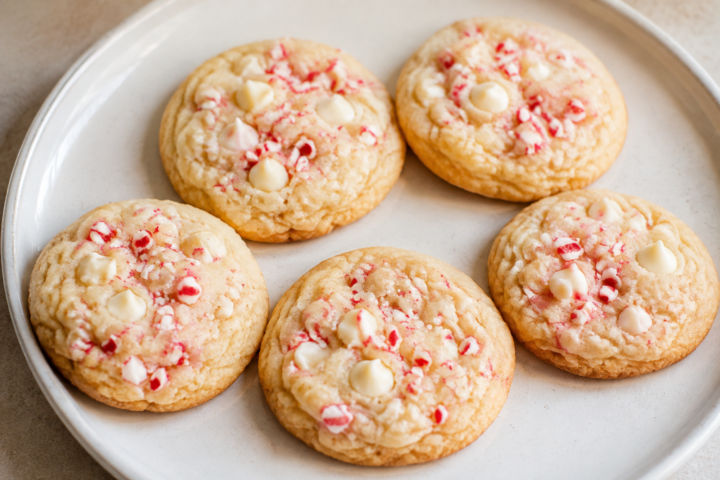
Recipe
White Chocolate Peppermint Cookies
White chocolate peppermint cookies combine white chocolate chips and crushed candy canes in a tender holiday cookie.
Cook this recipe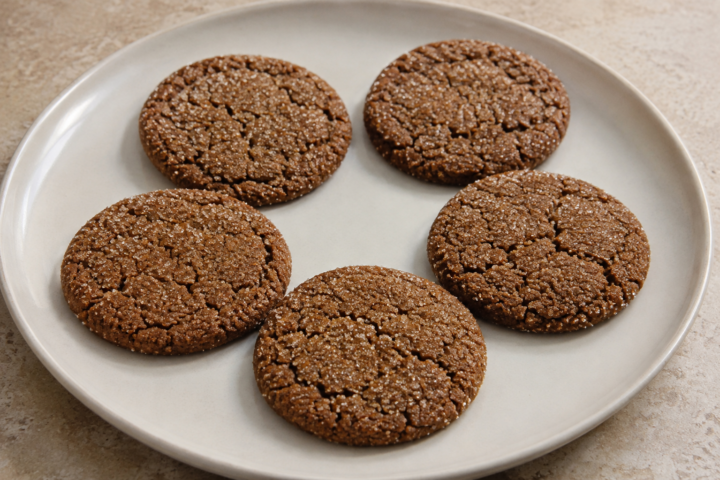
Recipe
Dark Molasses Ginger Cookies
Dark molasses ginger cookies combine fresh and ground ginger with cinnamon and cloves, then roll in sugar before a 10-to-12-minute bake.
Cook this recipe


